
Horn
The horn is usually located either in the middle of the steering wheel or on the end of a stalk. Rules for the use of the horn can be found in the Highway Code.
Lights
The light switches are usually on a stalk or a separate switch on the dashboard. There are three settings for the lights.
Sidelights – these can be used when leaving your car parked at night.
Dipped headlights – these should be used whenever visibility is reduced and during the hours of darkness.
Full beam headlights – these should be used during the hours of darkness on an unlit road with no oncoming or proceeding traffic. Do not use them in foggy conditions, as they will reduce visibility further. When the main beam lights are on you will see a blue warning light on the dashboard.
Whichever lights you switch on, the tail-lights and the number plate light will also come on.
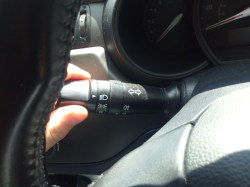
Fog lights
These should only be used when visibility is reduced to less than 100 metres. The fog lights will not usually work unless the dipped headlights are switched on.
When the rear fog lights are switched on you will usually see an orange warning light on the dashboard and a green light when the front fog lights are on.
Hazard warning lights
The switch for the hazard warning lights is usually red or has a large red triangle on it. Hazard warning lights should be used when your vehicle is causing a hazard to other road users due to a breakdown. They must not be used as justification for illegal parking, or when your car is moving, unless it is to warn other drivers of a hazard ahead on a motorway or unrestricted dual carriageway. When operated, all the indicators on the car flash at the same time. In the Kia Rio this button is positioned directly in the middle of the dash board.
Windscreen wipers and washers
On the opposite stalk to the indicators you should find the windscreen wipers and washers control. Operate this stalk with your fingertips, just like you do the indicator stalk.
Depending on the make and model of your car move the stalk either upward or downward to operate the wipers.
- One click will bring on the intermittent wipe;
- Two clicks will operate the normal speed wipers;
- The third click will operate the double speed wipers.


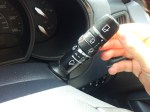
To wash the windscreen move the stalk either towards you or away from you, depending on the make and model of car. There will also be a control for the rear wiper and washer, if there is one fitted.


Demisters and heaters
All cars are fitted with demisters, these will help to keep your windows clear at all times. Make sure the heat and fan are turned up and the air is directed onto the windscreen. Most cars have a heated rear windscreen, some cars also have a heated front windscreen.

The dashboard
On the dashboard there are several warning lights and gauges. If any of the lights light up when you are driving, stop and check the user’s manual to find out what the problem is and whether or not you should drive the car further.
The speedometer will be displayed on the dashboard, this tells you what speed you are travelling at.
There might also be a rev counter, this tells you what speed the engine is rotating.
Each turn of the engine is known as a revolution, hence the term rev counter.
The fuel gauge and temperature gauge will also be displayed on the dashboard. The temperature gauge tells you the temperature of the engine, if it shows high or red you must not drive the car any further.
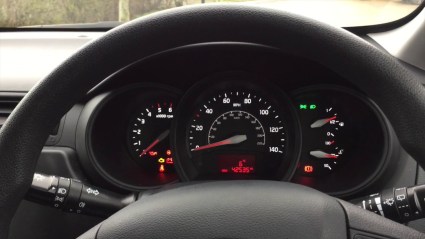
Your instructor will explain the ancillary controls in more detail and how these work in their car.
 jamiealmonddrivingtuition.com